Attractions
Shenyang is the capital of Liaoning Province, a sub-provincial city, a mega-city and the core city of Shenyang metropolitan area. It is an important central city in Northeast China, an advanced equipment manufacturing base and a national historical and cultural city.
1. Shenyang Imperial Palace
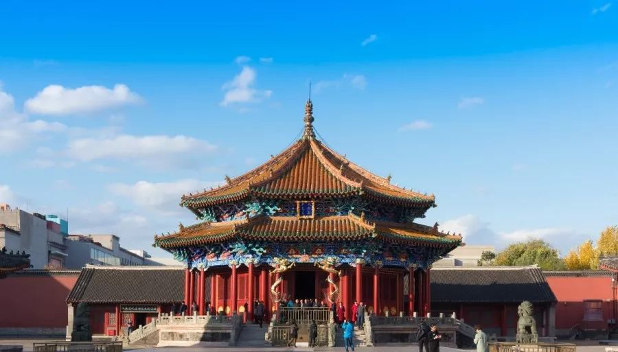
Shenyang Imperial Palace, known as Shengjing Imperial Palace, is located in Shenhe District, Shenyang City, Liaoning Province. It was the imperial palace in the early Qing Dynasty. The Shenyang Imperial Palace was built in the tenth year of Emperor Taizu's Mandate of Heaven (1625), and completed in the first year of Chongde (1636). It covers a total area of 63,272 square meters and a construction area of 18,968 square meters. It is not only one of the two remaining royal palace complexes in China, but also the only one outside the Chinese pass. According to the architectural layout and construction sequence, the Shenyang Imperial Palace can be divided into three parts: East Road, middle road and West Road. The east road includes the Grand Administration Hall and the Ten Kings Pavilion built during the period of Nurhachi, where the emperors held grand ceremonies and officials of the Eight banners worked. The middle road for the Qing Taizong period was built, is the emperor's political activities and concubine living place. The west road is the place where the emperors of the Qing Dynasty read books, watched plays and stored the Complete Works of the Four Repositories during their East tour to Shengjing. In architectural art, it inherits the ancient Chinese architectural tradition, integrates the architectural art of Han, Manchu and Mongolian, and has high historical and artistic value.
2. Zhang Shuai Palace
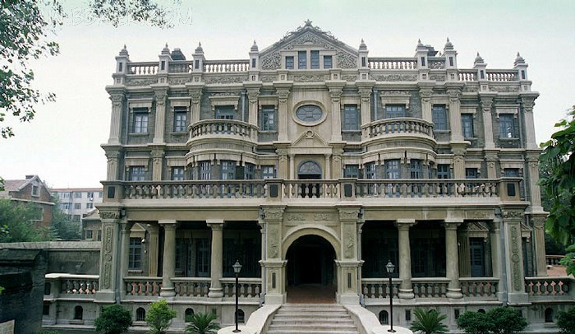
Zhang Shuai Palace was built in September 1914, the third year of the Republic of China, covering an area of 36,000 square meters, with a total floor area of 27,600 square meters. In the fifth year of the Republic of China (1916), Zhang Zuolin officially moved in, and then continued to expand, gradually forming a building system consisting of four parts, namely, the east courtyard, the middle courtyard, the west courtyard and the building outside the courtyard. Each architectural style is different, there are traditional Chinese style, Chinese and Western style, Roman style, Nordic style, Japanese style. There are mainly big brothel, small green house, west courtyard red building group and Zhao four Miss building and other buildings. In the late 20th century, Zhang Shuai Palace was listed as the national outstanding modern architectural complex. Zhang Shuai Mansion is the most well-preserved former residence of celebrities in Northeast China and was listed as a national AAAA scenic spot in 2004.
3. Qing Zhao Mausoleum
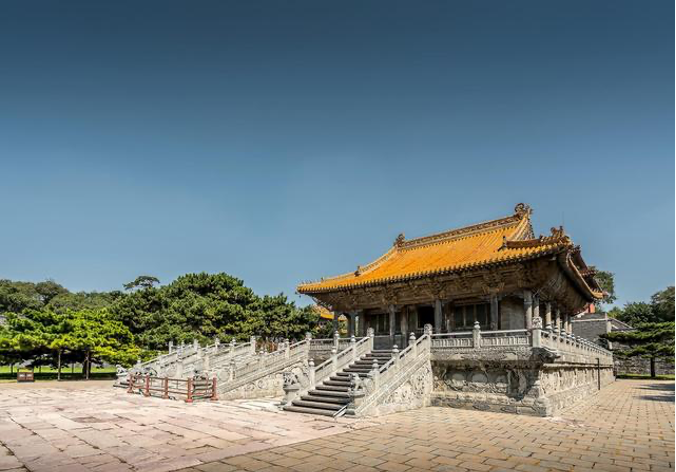
Qing Zhao Mausoleum is located at No. 12 Taishan Road, Huanggu District, Shenyang City, in the Beiling Park, is the mausoleum of Emperor Taiji of the Qing Dynasty and Empress Boljiit of Xiaodanwen. Because it is located in the north of Shenyang, it is also called Beiling. Qing Zhao Mausoleum is a national key cultural relic protection unit, in 2004 was assessed as a world cultural heritage. Qing Zhao Mausoleum, Qingfu Mausoleum and Yong Mausoleum together called the Three Tombs outside the Pass. Qing Zhao Mausoleum covers an area of 180,000 square meters, which was built in the eighth year of Chongde (1643), completed in the eighth year of Shunzhi (1651). The Qing Zhao Mausoleum is large in scale, complete in structure and unique in architecture. It is modeled after the Ming Mausoleum and has the characteristics of Manchu mausoleum. It is a model of cultural exchange between the Han and Manchu peoples.